Latest news

Back One in five private TV channels and more than a third of all SVOD and TVOD services in Europe belong to a US company

European Audiovisual Observatory publishes new free report on Audiovisual Media Services in Europe
One in five private TV channels and more than a third of all SVOD and TVOD services in Europe belong to a US company

Download "Audiovisual media services in Europe - 2022 edition" here


This new report finds that:

  • The European AV sector boasts a total of 12 275 audiovisual media services available in wider Europe (May 2022). Around three quarters of these are linear services (9 080 TV channels) and one quarter are non-linear services  (3 195 VOD services and video-sharing platforms). 
    Europe includes: EU27, Albania, Armenia, Bosnia and Herzegovina, Georgia, Iceland, Liechtenstein, Montenegro, North Macedonia, the Republic of Moldova, Norway, Serbia, Switzerland, Türkiye, the United Kingdom and Ukraine.
  • US players represent most non-European parent companies of AV services in Europe. Around one in five (19%) of all private TV channels (excluding local TV) are US-owned and over one third of all SVOD (38%) and TVOD (34%) services in Europe belong to a US company (For multi-country SVOD and TVOD services, one catalogue is counted as one service).
  • US players are all fully operating on pan-European level, serving numerous European markets. The Walt Disney Company, for example, has a virtual European omnipresence operating in 45 European TV markets.

To map the ever-changing European audiovisual sector the European Audiovisual Observatory, part of the Council of Europe in Strasbourg, has published a new edition of its annual report on TV channels and on-demand services in Europe. This report – Audiovisual Media Services in Europe – was authored by Agnes Schneeberger, Analyst within the Observatory’s Department for Market Information.

One in four audiovisual media services in Europe is an on-demand service

The European audiovisual media services sector has been shaped by the development of its unique national media ecosystems. This diversity is reflected by a sector boasting a total of 12 275 audiovisual media services which are available in wider Europe (May 2022). Around three quarters of these are linear services (9 080 TV channels) and one quarter are non-linear services (3 195 VOD services and video-sharing platforms).

The content of AV services in Europe reveals significant differences between linear and non-linear services. While TV programming is largely defined by thematic fragmentation, on-demand services have a clear focus on film and TV fiction content.

With regards to ownership, the European TV market is divided into a public sector with mainly generalist programming available on DTT networks and a private sector which has expanded into thematic cable and satellite channels. Almost all on-demand services are privately owned (97%). Public service media have entered the market as well, mostly offering catch-up of their linear programming. One in five public on-demand services are for pay, for example the international version of the BBC iPlayer.

US players prominent in European TV and on-demand sector

Non-European players have taken a strong foothold in the European AV market. One in four of the top 50 TV groups and more than a third of the top 50 groups for on-demand services has a non-European parent company.

US players represent the largest group of non-European parent companies of AV services in Europe. Around one in five (19%) of all private TV channels (excluding local TV) are US-owned and over one third of all SVOD (38%) and TVOD (34%) services in Europe belong to a US company.

US players are all fully operating on a pan-European level, serving numerous European markets. The Walt Disney Company, for example, has a virtual European omnipresence operating in 45 European TV markets.

With regards to their establishment hubs, pan-European players employ different strategies. Netflix, for example, uses a centralized strategy with a single country of establishment from where it is targeting the European markets. A core hubs strategy is used by the BBC, where typically a small number of countries serve as a basis to target various national markets. AT&T, by contrast, applies a decentralized strategy where a larger number of establishment hubs serve the European markets.
 

Strasbourg 5 January 2023
  • Diminuer la taille du texte
  • Augmenter la taille du texte
  • Imprimer la page
Other News

Back European admissions to non-national European films down by 8% in Europe, up by 36% in the US

European Audiovisual Observatory publishes new free report on volume of theatrical film export in 2019
European admissions to non-national European films down by 8% in Europe, up by 36% in the US

Download "The Circulation of European Films in non-national markets – Key figures 2019" here

  • In 2019, admissions to European non-national films decreased by 8% in Europe, while increasing in extra-European markets.
  • The growth in admissions to European export films was the result of a jump in admissions to European films in the US which confirmed its position as the largest export market for European films.
  • Germany and France were the top export markets for European films in Europe, generating respectively 12.2 million and 11.6 million admissions to non-national European films.
  • In 2019 UK films dominated European film exports, accounting for 13% of European film exports on release and 44% of total non-national admissions to European films worldwide.

The European Audiovisual Observatory has just released an updated edition of the report "The Circulation of European Films in non-national markets – Key figures 2019".  This study, authored by Patrizia Simone, Film Analyst in the Observatory’s Department for Market Information, looks at the volume and theatrical performance of European films in non-national markets, i.e. theatrical film exports. The study sample includes 48 markets, including 34 European and 14 non-European territories. The analysis is based on 2019 data and complemented by a five-year data series for the period 2015 to 2019.

Note: In this analysis “European” refers to the 47 member states of the Council of Europe.

The number of European film exports continued to increase in 2019

In 2019 an estimated total of 3 954 European films were on theatrical release in at least one non-national market worldwide. This is the largest number of non-national European films on release in the past five years and represents about 51% of the total number of European films tracked to be on release globally.
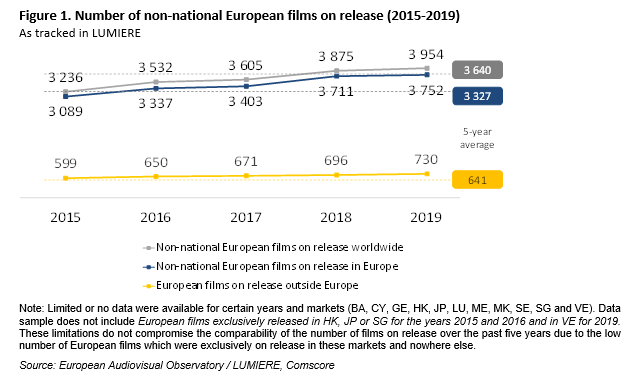
Admissions to European export films dwindled in European markets but rose outside Europe 

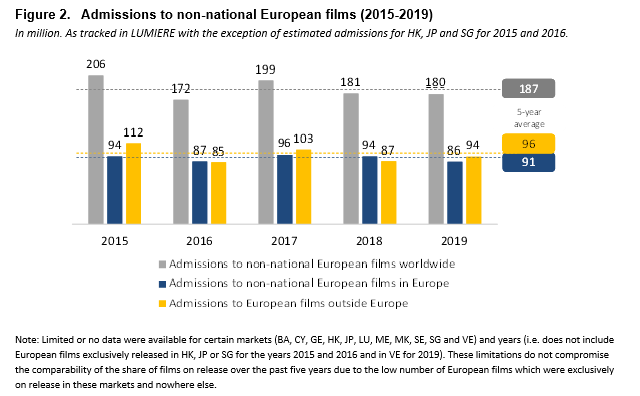
European export films cumulatively sold around 180 million admissions in non-national markets in 2019, representing 41% of total admissions to European films worldwide. These levels are well in line with 2018 but significantly below the values registered in 2015 and 2017.  
Of these 180 million total admissions to European export films, 86 million were generated in non-national markets in Europe, down  8% from 94 million in 2018, marking a five-year low. Conversely, outside of Europe admissions to European export  films rose to 94 million tickets in 2019 (8 million more than in 2018), thus accounting for 52% of total export admissions for the year.
The US was the top export market for European films in 2019

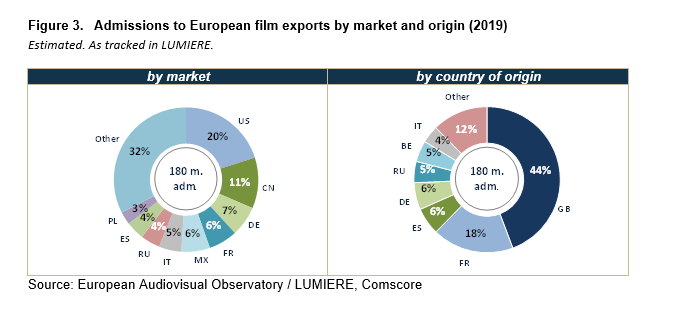
As export admissions declined in most non-national territories in 2019, interannual growth can be ascribed to a hike in ticket sales to European films in the US. With a total of 36.1 million ticket sales to European films (+36% and +11.1 million on 2018), the US confirmed its position of top export market for European films, generating as much as 20% of total export admissions for the year. This compares to 20.4 million admissions in China (11%) where ticket sales to European films dropped below the five-year average value. Accounting for 7% (12.2 million) Germany took third position following at a clear distance, ahead of France (11.6 million) and Mexico (11.5 million).
UK films dominated European film exports in 2019

UK and French films cumulatively accounted for 37% of export films and 62% of total admissions to European export films in 2019. UK films took the lion’s share as alone they accounted for 44% of total non-national admissions to European films worldwide, despite representing only 13% of European film exports on release in 2019. Conversely, French export films (24% of export films on release) accounted for only 18% of global non-national admissions to European films.

Strasbourg, France 25 March 2021
  • Diminuer la taille du texte
  • Augmenter la taille du texte
  • Imprimer la page

Yearbook online

A unique source of data on:
• television • film • video • on-demand audiovisual services in 43 European countries

  • Over 100 indicators
  • 10-year time series
  • For 43 countries

More information and subscriptions available here

Monthly Wrap Up

Subscribe to our monthly newsletter to get links to our latest film, TV and VOD publications.

You’ll also get advance invitations to our forthcoming events. Rounding off with links to our recent conference presentations. What’s not to like?

To join our mailing list:

 email Alison Hindhaugh

  telephone on + 33 (0) 3 90 21 60 10 (direct)

VOD dashboard: all our key VOD data in one Excel file

All the main data on VOD:

  • number of services
  • subscriptions
  • revenues
  • main players
  • composition of catalogues
  • viewing time 
  • and more

Link to the Dashboard

Events and Diary

Visit our Events page for up to date details of Observatory events, plus information on events attended by our talented team.

You can download our conference presentations from this page too!

Click here

Watch Our films

Visit our YouTube channel to watch our latest films and conferences.

Click here

FOLLOW US ON SOCIAL MEDIA


Watch our videos