

Latest news

Back 44 000 European films and over 12 650 European TV seasons are currently available on 462 VOD services in Europe

European TV content data now freely available for the first time in the European Audiovisual Observatory’s LUMIERE VOD database
44 000 European films and over 12 650 European TV seasons are currently available on 462 VOD services in Europe

The Observatory is, for the first time, including television content (series and TV films) in its LUMIERE VOD database. This data is freely available in the database.

This free access directory is supported by European Commission’s Creative Europe programme.

Access LUMIERE VOD free here

Data from LUMIERE VOD on TV content (for 46 European countries and analysed in November 2020) shows: 

  • The British animation series ‘Peppa Pig’ (season 1) was the top TV title present in VOD catalogues in Europe. This series also represented the oldest content in our list of top 20 TV seasons
  • The TV series with the largest number of available seasons were two British classics: quiz show ‘Have I got news for you’ (60 seasons) and soap ‘Coronation Street’ (59 seasons)
  • The oldest TV content available was David Attenborough’s ‘Zoo Quest’ series, from 1954
  • The United Kingdom was the main provider and exporter of TV content as it produced half of all European TV seasons available on VOD in Europe
  • Although 60% of TV content was less than 10 years old, the average year of production of all TV seasons found on VOD in Europe was 1987

A new update of the European Audiovisual Observatory’s LUMIERE VOD, the European works directory provides data on the availability of 44 000 European film titles and over 12 650 TV seasons (TV content is analysed at season level; one TV title corresponds to one TV season which was produced or minority co-produced by countries of the European Union and Council of Europe). The content analysed in the report figures in 462 different VOD catalogues (138 TVOD and 324 SVOD catalogues) in 46 European countries, representing 446 800 film presences and 65 100 TV season presences on VOD at the end of November 2020 (the notion of a ‘presence’ means that if season 1 of a given series is found in 27 catalogues in Europe, this is counted as 27 presences). 

Highlights and Insights

1. Availability of European TV content in VOD catalogues – origin and co-productions

1.1. Origin of unique TV seasons by first European production country

A total of 12 659 unique European TV seasons were available on VOD in Europe, and of these 12 309 had a European country as main producer. The United Kingdom (44%), Germany (17%), France (9%) and Spain (6%) together provided the majority of all available European TV titles on VOD.

1.2. Share of co-productions in the number of European TV titles

Only 12% of all European TV content available were co-productions, which is significantly lower than for films (30%). But when looking only at majority European productions, the share of co productions lowers even more to 9%. 
The main secondary co-production countries are the United States and Canada, but if we look only at European minority co-producers, Germany, France, and the United Kingdom are the main partners in co production.

2. Presence of European TV content in VOD catalogues – Focus on the actual presence of 65 100 European TV seasons

2.1. European TV seasons with the most presence on VOD services

British titles dominated the top 20 European TV seasons most found in the 462 VOD catalogues analysed, with half of the titles being produced by or co-produced with the United Kingdom.  Almost half of the top 20 titles were animation (9/20) and Denmark provided 20% of the top 20 titles with four seasons of the same animated series.

The average year of production was 2011 (2012 when looking only at animation titles) and the number 1 title by number of catalogues was also the oldest in the top 20.

2.2. Main production countries of European TV content by presence on VOD

The United Kingdom provided half of the European TV content presences on VOD in Europe at the end of November 2020. Together with Germany (16%) and France (9%), the three countries provided the majority (76%) of TV content available. 
The top providing countries did not correspond to the top 5 European production countries, with Sweden and Denmark providing more TV content than Italy. Scandinavia is traditionally an exporter of TV content and Sweden and Denmark together provided 5% of all TV seasons counted.
With the United Kingdom, the other non EU27 countries (but members of the Council of Europe) on the top producing countries list were Russia, Turkey, and Norway.

2.3. Mastering the circulation of European TV content

When looking at the capacity of making TV titles available on VOD services (how many catalogues are reached on average by each title) the most successful countries in proportion were smaller production capacity countries. On the other hand, strong producing countries such as France, Germany, Italy, or Spain had more difficulties in making their TV content circulate on European VOD. Finally, the United Kingdom managed to increase its dominance in unique TV seasons (44% of titles) and in TV content presence, reaching 51% of the total available offer and proving the comparatively higher circulation of British titles. 

2.4. Main services and catalogues

While TVOD services Amazon, iTunes and Maxdome offer the highest average number of European TV seasons in the countries they are available, Netflix and Amazon Prime Video are SVOD pan European players offering on average 597 and 290 European TV seasons in their country catalogues respectively.

Notes:

  • Data on VOD catalogues are for 46 European countries[1], representing all 27 Member States of the European Union and an additional 19 Member States of the Council of Europe.
  • LUMIERE VOD is supported by the European Commission’s Creative Europe MEDIA Programme.
  • The data on the presence of European content on VOD catalogues in Europe for LUMIERE VOD was obtained through our main partnership with JustWatch and participation of Amazon, Chili, EUROVOD, Filmtoro, Netflix and la Pantalla Digital.

[1] AD        AL           AM          AT           AZ           BA           BE           BG           CY           CZ           DE           DK           EE

  ES          FI             FR            GB           GE           GR           HR           HU           IE             IS             IT             LI             LT

  LU         LV           MC          MD         ME          MK          MT          NL           NO          PL           PT           RO          RS 

  RU         SE            SI             SK           SM          TR           UA


Strasbourg, France 2 February 2021
  • Diminuer la taille du texte
  • Augmenter la taille du texte
  • Imprimer la page
Other News

Back Just ahead of BREXIT deadline, UK once again named the largest audiovisual market in greater Europe

European Audiovisual Observatory publishes 2018 data on audiovisual media services in Europe from the MAVISE database.
Just ahead of BREXIT deadline, UK once again named the largest audiovisual market in greater Europe

This new report finds that:

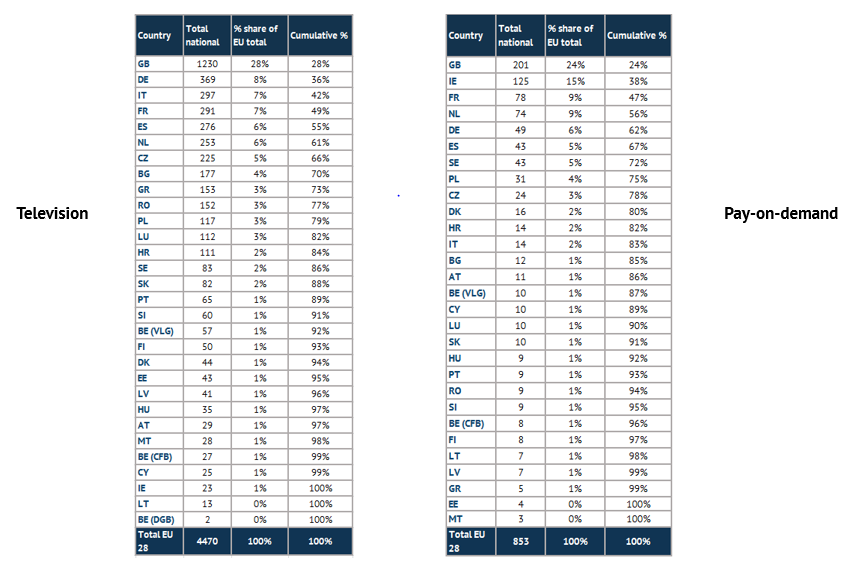
  • The United Kingdom was still by and large in 2018 the most prominent audiovisual market in greater Europe (EU28 plus countries listed in the foonote)[1] with 1 230 TV channels and 201 pay-on-demand services established in the country, many of which were targeting other European audiovisual markets.
  • The UK was also found to be the biggest contributor to the overall audiovisual services supply in the EU28. Around one quarter of all TV channels (28%) and pay-on-demand- services (24%) were established there.
  • At the end of 2018, there were 11 123 TV channels (including 5 039 local channels) and 2 917 on-demand services[2] available in greater Europe.
  • A total of 5 880 TV channels were established in greater Europe (excluding local channels), of which 4 470 were based in the EU28 and so were 968 pay-on-demand services (i.e. 853 in the EU28). Overall 4 838 TV broadcasting licences (excluding local licences) were issued (i.e. 3 555 in the EU28).

The European Audiovisual Observatory, part of the Council of Europe in Strasbourg, has just published a brand new publication “Audiovisual media services in Europe: Market insights”. Based on data analyses of 2018 data from the MAVISE database, this publication provides an overview of the European audiovisual media landscape from three different perspectives. The first focuses on the supply of audiovisual media services in Europe, presenting figures for television and on-demand services available and established in the European markets. The second perspective looks at the access and distribution of AV services in Europe, noting the dominance of pay business models in the sector. The third perspective highlights the growing footprint of targeting audiovisual media services in Europe that serve non-domestic markets.

1. The United Kingdom is still the largest audiovisual market in greater Europe

  • The United Kingdom was still by and large the most prominent audiovisual market in wider Europe with 1 230 TV channels and 201 pay-on-demand services established in the country, many of which were targeting other European audiovisual markets.
  • The UK was also found to be the biggest contributor to the overall audiovisual services supply in the EU28. Around one quarter of all TV channels (28%) and pay-on-demand- services (24%) were established there.
  • At the end of 2018, there were 11 123 TV channels available in Europe[3] of which 5 039 were local TV channels. Further, there were 2 917 on-demand services[4] available in Europe including services established outside of Europe which target the European markets; among these were
  • 1 624 catch-up TV services, 1 081 pay-on-demand services and 212 free on-demand services.
  • There were 5 880 TV channels established in Europe (excluding local channels) at the end of 2018, of which 4 470 were based in the EU28. European regulatory authorities issued 4 838 TV broadcasting licences (excluding local licences) of which 3 555 were issued in the EU28. Of the TV channels established in Europe 8% were publicly owned while 91% belonged to a private company and 1% had a mixed ownership (similar figures for the EU28); around 28% of TV channels were available in HD format and the same percentage had a catch-up TV service on offer; around 4% of TV channels had a time-shifted version (identical figures for the EU28).
  • Of the 968 pay-on-demand services established in Europe 853 were based in the EU28; among these, just 2% were owned by public service broadcasting organisations and 1% had a mixed ownership.

Concentration of TV channels and pay-on-demand services established in the EU28 | 2018 - In number of services and % share
Source: MAVISE database 2018

2. Pay business models dominate

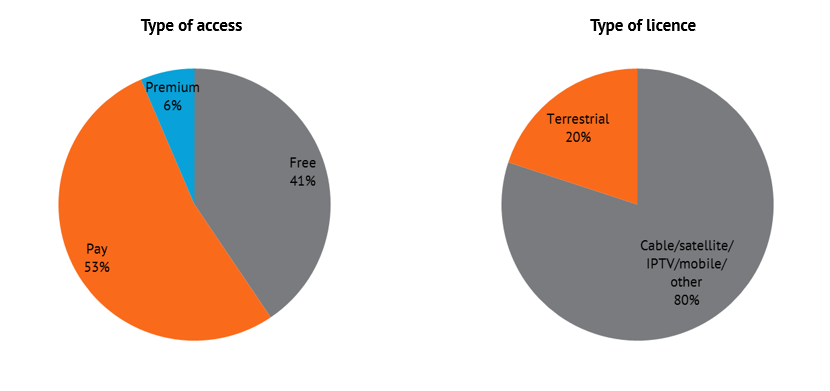
  • One out of five television services established in the Europe* by 2018 was accessible via digital terrestrial television (20%), and the rest could be accessed via cable, satellite, or Internet protocol television (IPTV).
  • Most television channels were pay/or premium services while 41% established in Europe were available free-to-air. The results were similar for the EU28.
  • The dominant business model for pay-on-demand services was subscription video-on-demand (SVOD) (59%), which came before transactional video-on-demand (TVOD) (41%).

Breakdown of TV channels established in EUR40 + Morocco by type of access and kind of licence | 2018 - In % share
Source: MAVISE database 2018

3. Growing footprint of audiovisual services targeting other markets 

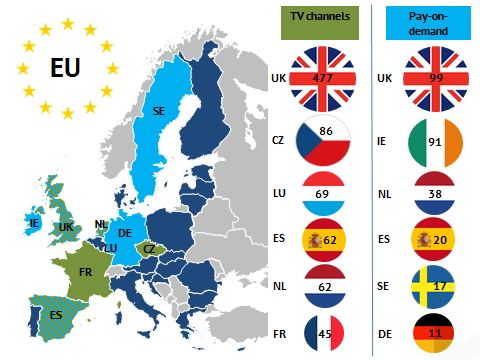
  • As with television (i.e. Europe n=563; EU28 n=477), the United Kingdom was in 2018 by far the major hub for pay-on-demand services targeting foreign markets with a total of 130 services aimed at other European markets of which 99 were serving the EU28 alone.
  • More than one fifth of all TV channels (21%; n=917) and over a third (36%; n=306) of pay-on-demand services based in the EU28 were specifically targeting other EU28 markets. In Europe* 19% (n=1136) of TV channels and 43% (n=413) of pay-on-demand services were serving non-domestic markets. They were predominantly owned by large broadcasting and entertainment corporations, the majority of which are of American origin.
  • The United Kingdom, the Czech Republic and Luxembourg accounted for 69% of all TV channels targeting other EU28 markets, and so were 75% of pay-on-demand services based in the United Kingdom, Ireland and the Netherlands.

Top audiovisual media hubs primarily targeting other EU28 markets by country | 2018 - In number of services
Source: MAVISE database 2018

Access MAVISE DATABASE here

1] Europe includes the EU28, Albania, Armenia, Bosnia-Herzegovina, Georgia, Iceland, Liechtenstein, Montenegro, North Macedonia, Norway, the Russian Federation, Switzerland, Turkey and Morocco
[2] Figures for on-demand services available in Europe include both free and pay service
[3] Ibid
[4] See footnote 1

Strasbourg, France 10/10/2019
  • Diminuer la taille du texte
  • Augmenter la taille du texte
  • Imprimer la page

IRIS Legal Monthly Newsletter

Short reporting on all the latest legal developments in the film, television and streaming industries as well as public policy developments at national and European level – delivered to your mailbox every month!

Monthly Wrap Up

Subscribe to our monthly newsletter to get links to our latest film, TV and VOD publications.

You’ll also get advance invitations to our forthcoming events. Rounding off with links to our recent conference presentations. What’s not to like?

To join our mailing list:

 email Alison Hindhaugh

  telephone on + 33 (0) 3 90 21 60 10 (direct)

VOD dashboard: all our key VOD data in one Excel file

All the main data on VOD:

  • number of services
  • subscriptions
  • revenues
  • main players
  • composition of catalogues
  • viewing time 
  • and more

Link to the Dashboard

Events and Diary

Visit our Events page for up to date details of Observatory events, plus information on events attended by our talented team.

You can download our conference presentations from this page too!

Click here

Watch Our films

Visit our YouTube channel to watch our latest films and conferences.

Click here

FOLLOW US ON SOCIAL MEDIA


Watch our videos