
Download “Adaptations in film and audiovisual fiction production in Europe - 2015-2024 figures”
A new report “Adaptations in film and audiovisual fiction production in Europe – 2015-2024 figures” has just been published by the European Audiovisual Observatory, part of the Council of Europe in Strasbourg, France. This report analyses adaptations in European cinematic feature film and audiovisual fiction production between 2015 and 2024. Its aim is to provide figures and context about the role of original sources in the production of film and audiovisual content in Europe.
This new report finds that:
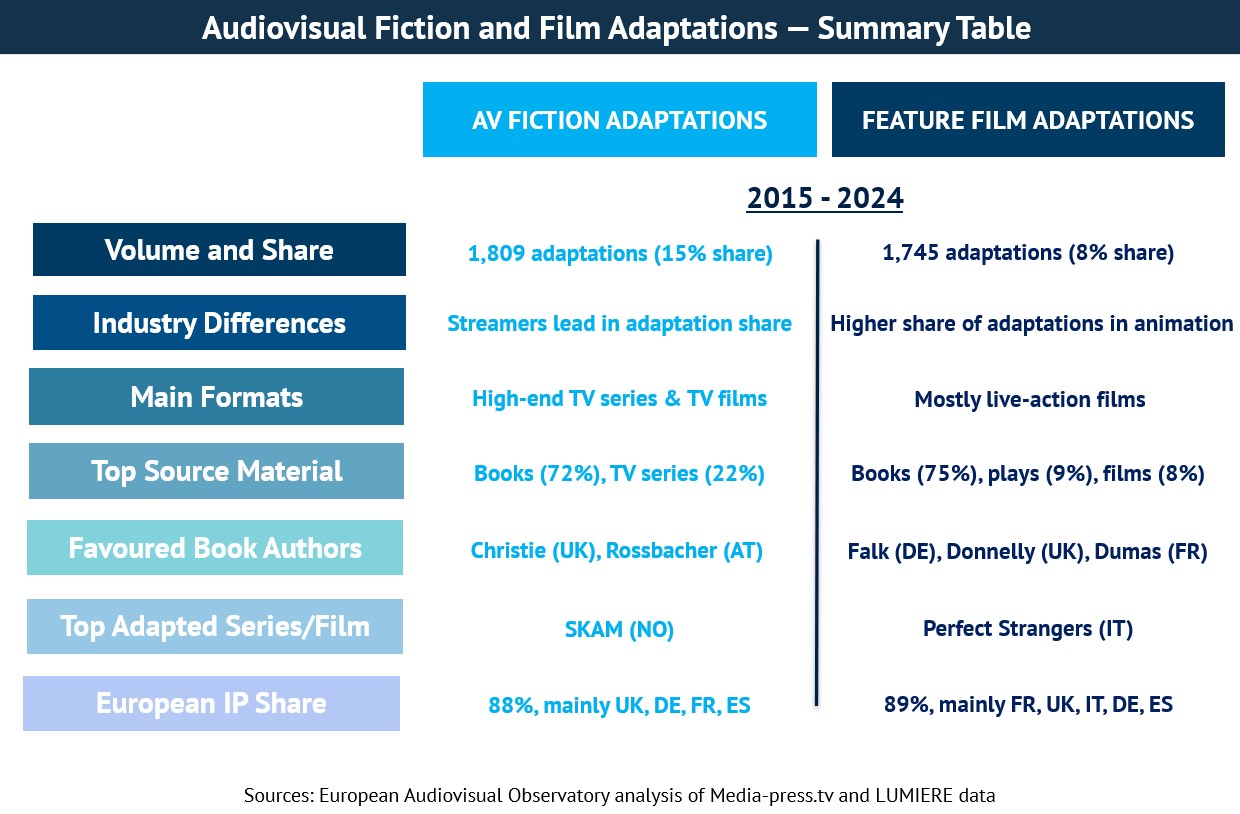
- TV fiction adaptations represent a solid mainstay of the industry, accounting for 15% of all audiovisual output between 2015 and 2024. In contrast, feature film adaptations are experiencing a downward trend, making up a significantly lower average share – just 8% - of European films released in cinemas.
- Books are the top source for European screen adaptations, accounting for 72% of audiovisual fiction adaptations and 75% of feature film adaptations.
- Streaming platforms demonstrate a stronger reliance on adaptations (22%) than traditional broadcasters (18% for private broadcasters and 10% for public broadcasters).
A decade of production data spanning from 2015 to 2024 reveals notable differences in the prevalence of adaptations in European audiovisual fiction and cinematic film production.
TV fiction adaptations represent a solid mainstay of the industry, accounting for 15% of all audiovisual output between 2015 and 2024. With an average annual volume exceeding 180 titles and 2,000 hours of content, adapted TV fiction maintained a stable development. (Here, “title” refers to either a TV film or a TV season, with each season of a TV series counted as a single title). The number of adaptation titles increased steadily from 2015, reaching a peak in 2022. Since 2023, however, the number of adaptations has declined, reflecting an overall downturn in the production of European audiovisual fiction titles.
In contrast, feature film adaptations are experiencing a downward trend, making up a significantly lower average share – just 8% - of European films released in cinemas. Despite an overall increase in the total number of films produced across Europe, the annual number of film adaptations has dropped from a pre-pandemic average of 200 to just 150. Although the share of feature film adaptations saw a modest rebound in 2024, from 6% to 8% (with 2024 figures still provisional), the long-term trend indicates that, as Europe’s film industry grows, it is becoming less reliant on adapted material.
Books are the dominant source for European screen adaptations
Literature is the top source for European screen adaptations, accounting for 72% of audiovisual fiction adaptations and 75% of feature film adaptations.
The “book to screen” trend is largely powered by European intellectual property - nearly 90% of all adaptations are based on European works, with authors from France, Germany, Italy, Spain, and the United Kingdom at the forefront. The industry demonstrates a marked preference for contemporary voices, with almost 70% of adapted books first published in the 21st century. Icons such as Agatha Christie and crime novelist Claudia Rossbacher are among the most adapted for audiovisual fiction, while detective novelist Rita Falk, children’s author Elfie Donnelly, and French classic Alexandre Dumas top the charts in feature film adaptations.
Book adaptations tend to be nationally focused, whereas the remake market is defined by international formats. The Norwegian TV series SKAM and the Italian film Perfetti sconosciuti (Perfect Strangers) serve as cross-border success stories, adapted across seven and eleven European markets, respectively.
Adapted content provides a vital bridge for international creative partnership: adaptations account for 24% of all audiovisual fiction co-productions, significantly more than the 17% observed in non-co-productions.
Streamers lead in adaptation share, with animation also favouring adapted content
Streaming platforms demonstrate a stronger reliance on adaptations than traditional broadcasters. Between 2021 and 2024, adaptations represented 22% of original fiction productions by streamers, compared to 18% for private broadcasters and 10% for public broadcasters. This trend is partly attributed to an import effect created by the presence of international streaming services operating in European markets, which tend to depend more on adaptations in their home markets.
Adaptations are also notably prevalent in animation. Animated feature films (21%) are more likely to be adapted from existing works than live-action feature films (12%), as they often draw on sources that lend themselves well to adaptation, such as children’s literature and comics.
 Meet the author - Agnes Schneeberger, our TV and VOD Markets Analyst, Department for Market Information
 + 33 (0) 3 90 21 60 10 (direct)
