
Download The European market volume for video games: Consumer spending 2021–2025
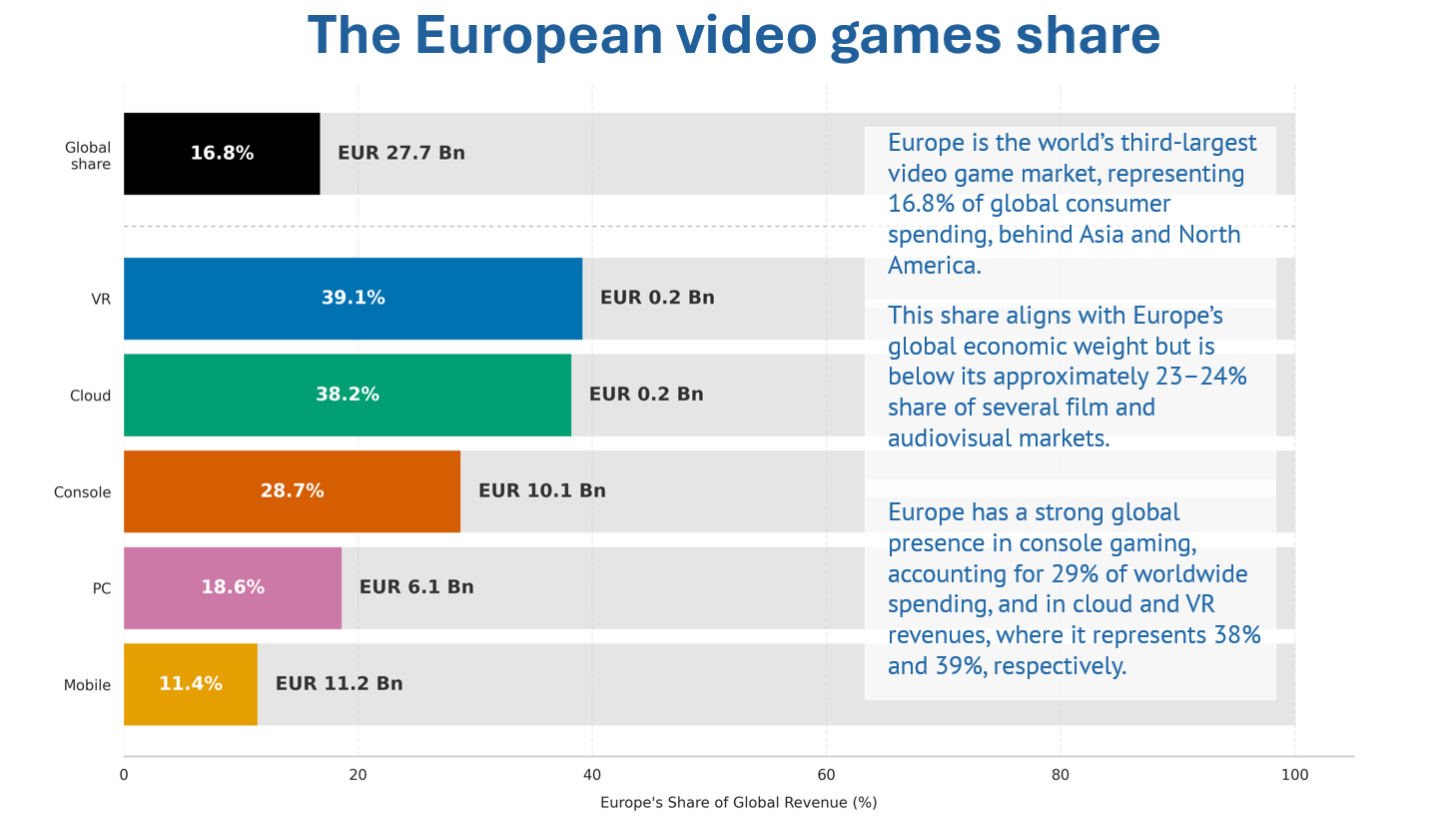
The global video games market amounted to EUR 167 billion in 2025. Europe ranks third with ~17% in consumer spending (EUR 27.7 billion), behind Asia (45%) and North America (30%).
The report The European market volume for video games: Consumer spending 2021–2025 has just been published by the European Audiovisual Observatory, part of the Council of Europe in Strasbourg. It marks the first publication of the Observatory in the field of video games and provides the first country-by-country analysis of video game consumer spending across 35 European territories.
Key findings
- Maturing market after years of growth: European consumer spending on video games nearly doubled over the past decade, rising from EUR 14.3 billion in 2016 to EUR 27.7 billion in 2025. Following an exceptional demand surge in 2020 (+19% YoY due to pandemic lockdowns), growth has stabilized into a mature average annual growth of 3%.
- Balanced multi-platform profile: Unlike Asian markets where mobile heavily dominates (73% share), Europe maintains a remarkably balanced platform ecosystem. With data from 2025, Mobile devices represent the largest single device segment at 40.3% (EUR 11.2 billion), closely followed by dedicated home consoles at 36.5% (EUR 10.1 billion) and PCs at 21.9% (EUR 6.1 billion).
- Emerging technologies remain marginal: While Cloud gaming and Virtual Reality (VR) represent around 1% of European spend combined, Europe plays a leading role globally, holding 38% of global Cloud gaming revenue and 39% of global VR revenue.
- Shift to recurring revenue: In-game microtransactions and downloadable content (DLC) generated 58.3% (EUR 16.2 billion) of consumer spending in Europe in 2025, consolidating the decade-long trend of replacing traditional box-product ownership. Subscriptions services grew by 371% over that decade to reach EUR 3.4 billion in 2025, while physical retail software dropped to just 5.2% of European spending.
Three distinct clusters based on platform architecture in Europe
The report highlights clear structural differences across European countries, grouping national markets into three distinct clusters based on platform architecture and on 2025 available data:
- Balanced multi-platform markets (console-heavy): Western and Northern European economies (e.g., UK, Germany, France, Spain) feature high per-capita spending and a strong home-console foundation (averaging 38% share) alongside digital subscription growth.
- PC-mobile dual ecosystems: Central and Eastern European countries (e.g., Poland, Czech Republic, Romania, Ukraine) show near-zero console presence (<1% share), relying instead on desktop PCs (41% share) and mobile devices (57% share) utilizing free-to-play live services.
- Mobile-dominant small markets: Microstates and island nations (Cyprus, Luxembourg, Malta) operate almost exclusively on mobile platforms (~99% share), bypassing physical retail and home hardware entirely.
Main European markets
The European video game market is heavily concentrated. Led by the UK, Germany and France, the eight largest European video game markets cumulatively accounted for 79% of total consumer spending in Europe in 2025.
- United Kingdom: EUR 5.93 billion
- Germany: EUR 5.67 billion
- France: EUR 4.12 billion
- Italy: EUR 1.90 billion
- Spain: EUR 1.57 billion
- Netherlands: EUR 1.04 billion
- Poland: EUR 990 million
- Belgium: EUR 680 million
The report is authored by Joan Ramon Rodriguez-Amat, the European Audiovisual Observatory’s Video Games Analyst, and marks the first output of the Observatory’s pilot project exploring the video games sector. Building on the Observatory’s long-standing expertise in analysing the legal and market dimensions of Europe’s audiovisual sector, as well as its public service mission to provide reliable, independent and transparent information, this initiative extends its analytical work to this evolving field. It aims to contribute to a better understanding of the sector, how it operates and how it is changing. Over the coming three years (2026 – 2028), this project will examine different aspects of the video games industry. In addition to this market report, work is underway on a report mapping existing public support schemes for the video games industry across European countries, scheduled for publication in early 2027.
 Meet the author - Joan Ramon Rodriguez-Amat, Video Games Analyst
 + 33 (0) 3 90 21 60 10 (direct)

